

 en






Happy: Friday the 13th is a normal day in Spain.
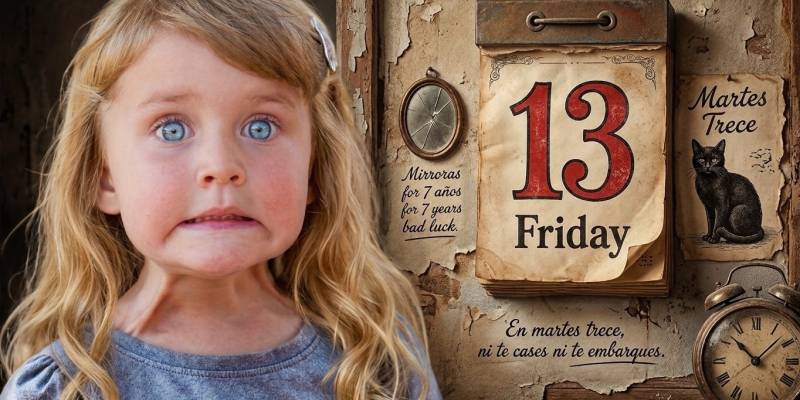
Friday the 13th appears on the calendar as an ordinary day, and Spaniards shrug their shoulders at it. They fear martes trece (Tuesday the 13th). Why it is precisely that day, nobody knows for sure. Friday the 13th is a day for many Belgians and Dutch people to pay extra attention. If you ask a Spanish neighbor about it, you usually get a blank stare back. In Spain, superstition revolves around the Tuesday that falls on the 13th. This year that was already the case on January 13 and October 13.
As the saying goes briefly: en martes trece, ni te cases ni te embarques (on Tuesday the 13th, neither get married nor embark on a journey). Superstitious Spaniards prefer to postpone a wedding or a major trip by a day. By the way, it is not scientifically proven that luck or misfortune depends on a date. Why is Tuesday so notorious?
Tuesday bears the name of Mars, the Roman god of war. The Spanish word martes comes directly from it. The news outlet Menorca Es Diari points out that this link with violence and destruction reinforces the day's reputation. The number thirteen provides even more ammunition. At the Last Supper, Judas sat as the thirteenth person at the table, and in Norse saga, the uninvited Loki joins as the thirteenth guest at a feast that ends badly.
Spanish stories also look for origins in history. According to one account, the Moors conquered the city of Xàtiva near Valencia in June 1276. That fits within the memory of a country that lived with and against the Moors for centuries. Others point to the fall of Constantinople on May 29, 1453, a Tuesday. Proof for both stories is lacking. You can read the whole story in our article about Tuesday the 13th as a true Spanish unlucky day. Where does Friday the 13th come from?
Anglo-Saxon superstition leans on Friday, the day on which, according to Christian tradition, the Romans crucified Jesus. The arrest of the Templars on October 13, 1307 also frequently pops up. French King Philip the Fair ordered it, and it was the beginning of the order's downfall. In 1907, American Thomas W. Lawson wrote a novel about a stockbroker who uses superstition to sow chaos in the financial market. Horror films later did the rest.
How is it in other countries?
Every country chooses its own bad-luck day. The website of the Canary Islands broadcaster Radio Televisión Canaria writes that Italians fear Friday the 17th. If you put 17 in Roman numerals (XVII) and jumble the letters, you read the Latin vixi, 'I have lived', a reference to death. In Japan and China, people avoid the number four, because it sounds like the word for death. In Japan they even use an alternative pronunciation, yon, to bypass that word. The fear of the number thirteen is called triscaidecafobia (fear of the number 13). Some buildings therefore skip the thirteenth floor. In Spain itself, that floor simply exists. Language guide Cintha writes in her thirty facts about Spain that Spaniards look at you strangely if you mention Friday the 13th as a day of bad luck. Worldwide, row 13 of seats is indeed missing in some planes and trains.
Why does the superstition endure?
Nobody knows whether the saying stems from superstition or the other way around. You can see it as one of the oldest marketing tricks: through endless repetition, an ordinary Tuesday sounds suspicious. Spain loves this kind of custom with a wink. Think of twelve grapes on New Year's Eve, red underwear, and money in your shoes, as we described in our overview of superstitions around the turn of the year. The next Tuesday the 13th falls on April 13, 2027. If you live in Spain or frequently go on vacation, keep in mind that a superstitious acquaintance would rather postpone your wedding or trip by a day.
Share