
 en
en






ECOLOGICAL SUCCESSION FOLLOWING FOREST FIRES: THE MULTI-LAYERED RECOVERY OF SPANISH ECOSYSTEMS
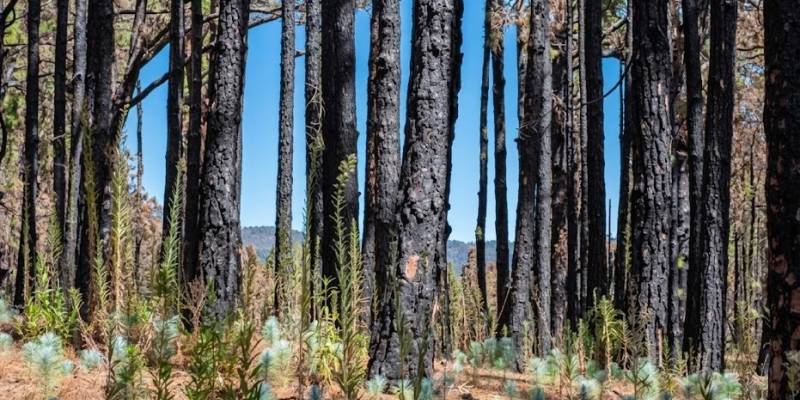
The regeneration of a fire-affected ecosystem in Spain is a complex, non-linear process driven by ecological succession, pyrophytic adaptations, and pedological factors. Although soil functions can partially recover within one to five years, the ecological recovery of a mature forest structure and function often takes decades to over a century.
With an annual burned area that reaches over 150,000 hectares during extreme drought years (particularly in fire-prone regions such as Castile and León, Madrid, Aragon, and Galicia), the dynamics of Mediterranean pyrogeography are high on the scientific agenda. Scientists and forest managers analyze resilience using variables such as fire intensity, soil matrix damage, and post-fire precipitation patterns.
1. Pedological Regeneration: Soil Chemistry and Hydrological Dynamics (1 to 5 years)
Soil recovery forms the foundation for ecological succession. Fire affects the soil through thermal alteration of organic matter and changes in hydrological dynamics:
- Erosion and Hydrophobicity: Severe fires burn the organic litter layer (humus) and vaporize organic compounds, which subsequently condense deeper in the soil. This creates a water-repellent (hydrophobic) soil layer. During initial heavy rainfall, this leads to severe surface runoff and soil erosion.
- Nutrient Flux: Ash contains high concentrations of inorganic cations (such as $\text{Ca}^{2+}$, $\text{Mg}^{2+}$, $\text{K}^{+}$), causing a short-term spike in soil pH and nutrient availability (the ash-bed effect). However, if these nutrients leach away before pioneer vegetation can take them up, the soil becomes impoverished.
- Microbial Recovery: Within 12 to 60 months, the microbial mycorrhizal network in the upper soil layer typically recovers, provided the heat at a depth of 5 cm has not remained above the critical threshold of 60–70 °C for an extended period.
2. Ecophysiology and Vegetation Succession (10 to 100+ years)
The return of vegetation depends on the ecological strategies of the present plant species. In the Mediterranean biome, two main strategies are distinguished:
A. Obligate Seeders
Trees such as Pinus halepensis (Aleppo pine) and Pinus pinaster utilize serotiny. Their cones remain closed until the heat of the fire melts the resin, releasing thousands of seeds onto a mineral-rich soil free of competition.
- Recovery time: A young stand forms within 10 to 20 years.
- Risk: If a second fire occurs within 15 to 20 years (before trees reach reproductive maturity), the seed bank vanishes, potentially leading to local extinction.
B. Obligate Sprouters
Oak species such as Quercus ilex (holm oak) and Quercus suber (cork oak) survive the fire underground via a well-developed root system (lignotuber) or thick insulating bark. They resprout rapidly from dormant buds.
- Recovery time: Vegetative regrowth often begins within a few months. Achieving original climax vegetation and canopy architecture, however, takes 30 to 50 years.
C. Non-adapted Species
In wetter, mixed forest areas (such as in Asturias and Northern Cáceres) featuring Fagus sylvatica (beech) or non-pyrophytic oaks, ecological succession may have to start from scratch (pioneer phase $\rightarrow$ shrubland $\rightarrow$ climax forest). This process lasts 80 to more than 120 years.
3. Functional Recovery: Carbon Sequestration and Water Balance
Research published in Forest Ecology and Management emphasizes that a visually "green" forest does not equal a functionally restored ecosystem.
Post-fire regeneration phase
├── Phase 1: Soil stabilization (1-5 yrs)    --> Microbial recovery & pioneer vegetation
├── Phase 2: Structural succession (10-30 yrs) --> Pyrophyte germination & vegetative regrowth
└── Phase 3: Functional climax (50-100+ yrs)   --> Full recovery of carbon storage & hydrology
- Carbon Balance ($\text{CO}_2$): A burned forest shifts from a carbon sink to a carbon source, as decaying wood and disturbed soils continue to emit $\text{CO}_2$ for years. It takes an average of 15 to 25 years for Net Primary Productivity (NPP) to become positive again.
- Hydrological Cycle: The regulation of evapotranspiration and groundwater recharge remains disrupted for several decades, increasing vulnerability to regional droughts.
4. Landscape Ecology and Anthropogenic Influence
The rate of ecological recovery is determined not only by natural factors, but also by human land use:
- Grazing Pressure (Pastoreo): The historical decline in extensive livestock farming (sheep and goats) has led to the accumulation of combustible undergrowth (fine fuels). Controlled post-fire grazing helps regulate fuel load, but overgrazing can destroy seedlings and cause soil compaction.
- Socio-economic Impact: Agricultural structures (such as vineyards and olive groves) traditionally serve as natural firebreaks. When burned agricultural plots are permanently abandoned, secondary succession of highly flammable brushwood occurs, increasing the risk of future megafires.
Conclusion for Management and Risk Analysis
A burned Spanish forest recovers across different timescales. While vegetative cover (the "green appearance") often recovers within a decade via adapted pyrophytes, the recovery of complex networks—such as deep soil structure, carbon storage capacity, and full biodiversity—takes 50 to over 100 years.
For property owners, land managers, and residents in forested areas, this means that the risk profile of a burned area changes long-term: in the first years due to heightened risk of erosion and mudslides, and in the following decades due to the high flammability of young, dense regeneration phases.
Share